Combine Therapy and Medication for Depression Treatment
- joeudesign
- May 26
- 8 min read

TL;DR:
Combining therapy with medication is more effective for moderate to severe depression because it addresses biological and emotional root causes. Early diagnosis, goal setting, regular communication, and gradual medication adjustments are crucial for successful integrated treatment. Research shows that combined approaches lead to higher symptom reduction, relapse prevention, and long-term coping skills.
Depression rarely responds well to a single solution. If you have tried medication alone and still felt stuck, or if you have done therapy but felt like something was missing, you are not alone. The decision to combine therapy medication depression treatment approaches together is one that many psychiatrists now consider the most effective path for moderate to severe depression. Research consistently shows that neither talk therapy nor antidepressants alone deliver the same results as both working together. This guide walks you through what to expect, how to start, and what to watch for.
Table of Contents
Key takeaways
Point | Details |
Combined treatment outperforms solo approaches | Therapy paired with medication addresses both biological and emotional roots of depression more fully than either alone. |
Proper diagnosis comes first | A thorough psychiatric evaluation helps you and your provider choose the right therapy type and medication starting point. |
Watch for common pitfalls | Never stop antidepressants abruptly, since managed tapering under clinical supervision prevents serious withdrawal effects. |
Outcomes improve with ongoing communication | Regularly telling your provider how medication affects your daily life leads to better, faster adjustments. |
Telehealth expands access in New York | Residents across New York State, including Westchester County and Brooklyn, can access integrated depression care virtually. |
What to know before you combine therapy and medication
Before you start any combined treatment, a few things need to be in place. Skipping these steps is one of the most common reasons people feel like treatment “isn’t working.”
Getting the right diagnosis matters more than most people realize. Depression is not a single condition. Major depressive disorder, persistent depressive disorder (dysthymia), and depression layered with anxiety or ADHD all respond differently to treatment. At 2ndarc, a thorough psychiatric evaluation comes before any prescription or therapy referral. This protects you and makes every subsequent step more targeted.
Understanding your therapy options helps you commit to the right one. The most common evidence-based options include:
Cognitive Behavioral Therapy (CBT): Targets negative thought patterns and behaviors that maintain depression
Interpersonal Therapy (IPT): Focuses on relationship patterns and life transitions that worsen mood
Psychodynamic therapy: Explores deeper emotional conflicts and past experiences
Dialectical Behavior Therapy (DBT): Particularly useful when depression overlaps with emotional dysregulation
Medication for depression is equally varied. SSRIs like sertraline and escitalopram are usually tried first. SNRIs, atypical antidepressants like bupropion, and, in complex cases, augmentation with other agents are all legitimate options. The right choice depends on your history, your symptoms, and how your body has responded before.
For children and adolescents, the considerations shift. Child and adolescent psychiatry requires careful attention to developmental factors and family dynamics. Families in White Plains, Westchester County, and Brooklyn have access to in-person appointments, while New York telehealth services make it possible to get care statewide without leaving home. Most major insurance plans cover these services, which removes one more barrier.
How to start combining therapy and medication
The process does not need to be overwhelming. Here is a clear, step-by-step way to approach integrated depression care.
Schedule a psychiatric evaluation. This is the foundation. A psychiatrist will assess your symptoms, history, and any previous treatments. At 2ndarc, appointments are often available within 24 hours. Do not wait until a crisis to take this step.
Set collaborative treatment goals. What does improvement look like for you? Sleeping through the night, returning to work, reconnecting with your family? Concrete goals give both you and your providers a shared target and make progress measurable.
Begin medication under close supervision. Most antidepressants take two to four weeks to build therapeutic effects. During this window, your psychiatrist should check in regularly. Behavioral treatments complement pharmacotherapy, which means starting therapy early in this period helps fill the gap before medication reaches full effect.
Start therapy sessions concurrently. Aim for weekly sessions in the early months. CBT and IPT have the strongest evidence base for depression, but the “right” therapy is also the one you will actually attend. Discuss your schedule with your therapist and find a rhythm that is sustainable.
Track your symptoms between appointments. Simple mood tracking apps or even a handwritten journal help you notice patterns your provider cannot see. Note sleep quality, energy, appetite, and moments of emotional relief or setback.
Review and adjust at every appointment. Medication management is not a “set it and forget it” process. If a medication is not working after a fair trial, there are many alternatives to explore. About one-third of adults with depression do not respond to the first two standard antidepressants and need adjusted or combined strategies.
Keep your psychiatrist and therapist informed about each other’s work. Even when they are at separate practices, sharing relevant updates between providers closes critical gaps. Ask your psychiatrist if they can coordinate directly with your therapist when needed.
Pro Tip: Write down two or three specific things that changed since your last appointment before you walk into any follow-up visit. Providers can only adjust your plan based on what you share. The more specific you are, the faster your care improves.
Common pitfalls when combining treatment approaches
Even with the best intentions, certain patterns reliably derail combined treatment. Knowing them in advance saves real time and distress.
Stopping medication without guidance. This is one of the most serious mistakes. Stopping medication abruptly can trigger withdrawal symptoms including dizziness, irritability, and a sharp mood crash. Any discontinuation should follow a supervised tapering schedule.
Quitting therapy when you start to feel better. Medication can lift symptoms enough that therapy starts to feel unnecessary. This is actually the ideal time to do the deeper work. Stopping therapy prematurely leaves you without the skills to maintain gains when life gets difficult.
Expecting immediate results. Most people feel meaningful improvement within six to eight weeks when combining therapy and medication. Expecting results in two weeks and giving up on week three means abandoning a treatment that was about to work.
Letting stigma delay care. This affects families seeking help for children and adolescents especially. School refusal, withdrawal from activities, and mood changes in teens are not phase behavior; they are symptoms worth evaluating. Early treatment produces better long-term outcomes.
Under-reporting side effects. Effective treatment plans depend on ongoing honest communication about how medication affects daily life. If a medication is making you feel foggy, gaining weight, or disrupting sleep, say so. There are alternatives.
Pro Tip: Set a calendar reminder to check in with your prescribing psychiatrist at the three-week mark after any new medication starts. Most side effects peak in the first two to four weeks, and early communication prevents unnecessary suffering and dropout.
What outcomes you can expect from combined treatment
Understanding what research actually shows helps set realistic and motivating expectations.
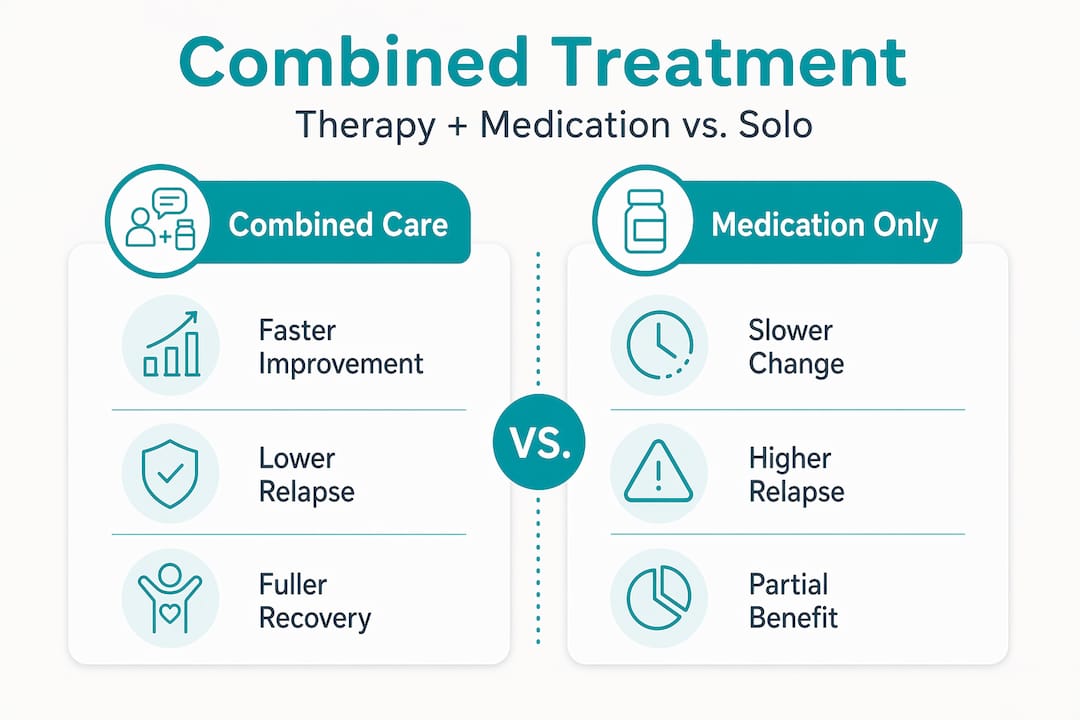
Therapy combined with antidepressants consistently outperforms medication alone across multiple studies, particularly for moderate to severe depression. The advantage goes beyond symptom reduction. Combined treatment lowers relapse rates because therapy builds lasting coping skills that medication cannot teach.

For patients with suicidal ideation, newer research is especially encouraging. A recent study found that ketamine followed by low-dose buprenorphine produced a 76% reduction in suicidal ideation compared to a 43% reduction with ketamine alone. Separately, acupuncture combined with antidepressants showed symptom improvements within the first week and better tolerability than medication by itself. These findings reinforce that novel combination strategies continue to expand what is possible for people who have not responded to standard care.
Outcome | Medication alone | Combined therapy and medication |
Symptom reduction | Moderate | Significantly higher |
Relapse prevention | Lower | Substantially improved |
Suicidal ideation reduction | Variable | Up to 76% in some combination studies |
Tolerability of side effects | Standard | Improved with adjunctive approaches |
Long-term coping skills | Not addressed | Built through therapy component |
For many patients, integrated care also changes the experience of treatment itself. Therapy provides a space to process how depression has affected relationships, work, and self-image. Medication reduces the biological weight enough that this work becomes possible. Together, they create a momentum that neither builds alone.
“I had tried medication twice before and always stopped because I felt like a zombie. When I finally added therapy, I actually learned why I kept stopping. Within four months, I felt more like myself than I had in years.”
For New York State residents, including those managing postpartum depression or perinatal mental health challenges, telehealth psychiatry makes it possible to receive this kind of integrated care from wherever you are.
My perspective on personalized, ongoing care
I have seen something consistent across years of watching people work through depression treatment: the patients who do best are not always the ones who started with the best medication match. They are the ones who built a real relationship with their prescriber and stayed honest about what was and was not working.
The biggest mistake I see is treating a prescription like a final answer. Medication is a starting point. What happens in the weeks and months after the first script is written determines almost everything. A dose that works well at month one may need adjustment at month four as life circumstances shift. The therapeutic relationship that allows those conversations to happen freely is what actually moves the needle.
I have also seen how dangerous abrupt stops are. Patients often describe quitting antidepressants because they “felt fine,” not realizing that feeling fine was the medication working. The supervised tapering conversation is not a formality. It genuinely protects people. If you are considering stopping your medication, please bring it to your prescribing psychiatrist before you do anything.
To anyone just starting to explore how to combine therapy and medication: give it time, stay in communication, and resist the pressure to evaluate too early. The most meaningful changes often happen quietly, between appointments.
— Martin
Get personalized depression care at 2ndarc
If you are ready to explore a combined approach to treating depression, 2ndarc is here to support you every step of the way.

2ndarc provides personalized psychiatric care for children, adolescents, and adults across New York State, with in-person appointments in White Plains and Brooklyn. The care team specializes in depression, anxiety, ADHD, OCD, and other conditions that often accompany and complicate depression. Every treatment plan is built around your specific history and goals, not a template. Most major insurance plans are accepted, and telehealth services make it easy to get started wherever you are in New York. Appointments are often available within 24 hours. Book your evaluation online and take the first step toward care that actually fits you.
FAQ
What does it mean to combine therapy and medication for depression?
Combining therapy and medication means using both talk therapy (such as CBT or interpersonal therapy) and antidepressant medication together as part of one coordinated depression treatment plan. Research shows this approach is more effective than either treatment alone, especially for moderate to severe depression.
How long does it take for combined treatment to work?
Most people notice meaningful improvement within six to eight weeks of starting both therapy and medication together. Medication typically takes two to four weeks to reach full effect, while therapy skills build progressively over several sessions.
Is it safe to stop antidepressants once therapy is going well?
Never stop antidepressants without guidance from your prescribing psychiatrist. Abruptly stopping medication can cause withdrawal symptoms, and any discontinuation should follow a supervised tapering plan.
Can children and teenagers receive combined depression treatment?
Yes. Combined therapy and medication is used in child and adolescent psychiatry with careful attention to age-appropriate dosing and developmental factors. In New York State, families can access these services in person or through telehealth psychiatry.
What if medication alone has not worked for my depression?
One-third of adults with depression do not respond adequately to the first two standard antidepressants. This does not mean treatment has failed. It means your plan needs adjustment, which might include combination medication strategies, a different therapy modality, or both together.
Recommended


Comments