How Long Depression Treatment Takes: What to Expect


TL;DR:
Depression treatment duration varies by method, severity, and personal history, often requiring months of consistent care. Psychotherapy can be effective in as few as 6 to 8 sessions, while rapid-acting treatments like ketamine and ECT provide swift relief but need ongoing follow-up. Setting realistic expectations emphasizes that full remission tends to take several months, with ongoing maintenance crucial to prevent relapse.
Depression treatment duration is defined by the method used and the individual’s clinical history, typically spanning weeks to months for initial improvement and up to two years for full maintenance. Understanding how long depression treatment takes helps patients and families set realistic expectations, stay committed to care, and recognize that slower progress is not the same as failure. Most treatments follow three phases: acute (symptom reduction), continuation (preventing relapse), and maintenance (long-term stability). The right timeline for you depends on factors like severity, age, and whether medication, therapy, or a combination approach is used.
How long does depression treatment take across different methods?
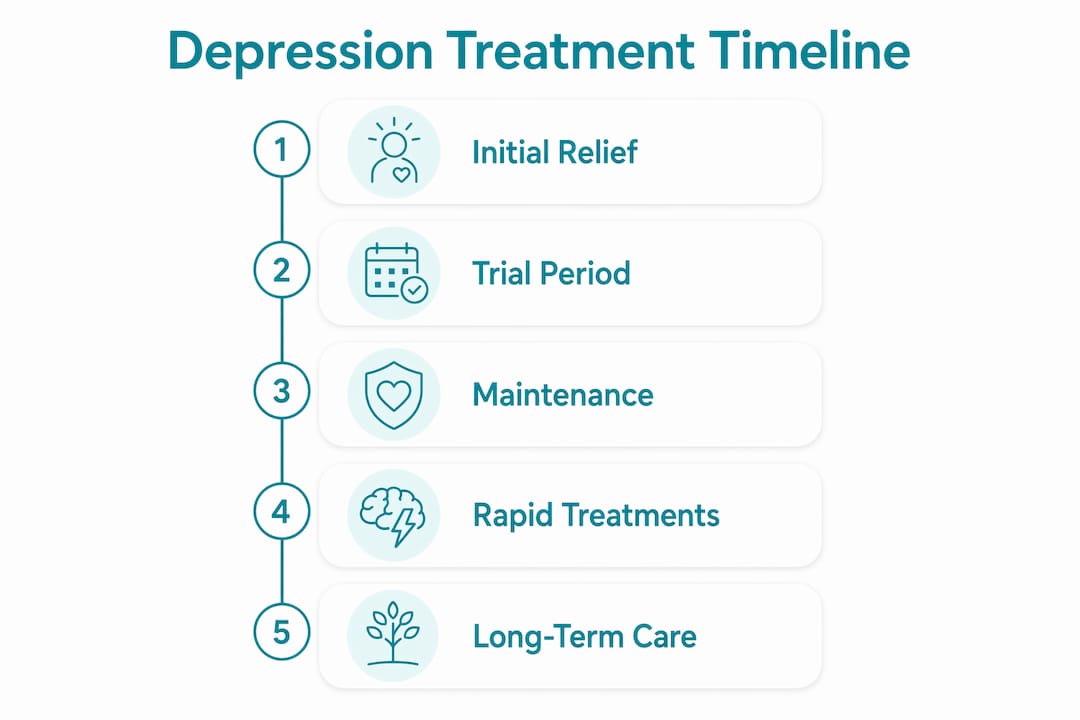
Antidepressant medications are the most commonly prescribed treatment for moderate to severe depression, and they operate on two distinct timelines. Initial symptom relief typically begins within 2 to 8 weeks, though full therapeutic benefit may take longer. This dual timeline means patients often feel partial improvement early but need to stay consistent for the medication to reach its full effect.
The three phases of antidepressant treatment are:
Acute phase: The first 6 to 12 weeks, focused on reducing active symptoms to remission
Continuation phase: Roughly 4 to 9 months after remission, aimed at preventing immediate relapse
Maintenance phase: Long-term treatment for patients with recurrent or severe depression, sometimes lasting years
Most people need antidepressants for about 6 to 12 months to help prevent relapses, with adults over 50 often requiring up to 2 years. This extended window reflects the biological reality that the brain needs sustained support to consolidate recovery, not just symptom suppression.
One detail many patients miss: stopping antidepressants too quickly causes discontinuation syndrome. Antidepressants should be tapered gradually over about 2 months to avoid symptoms like nausea, chills, and anxiety. This tapering period adds to the total treatment timeline and should always be supervised by a clinician.
In clinical practice, the first antidepressant prescribed does not always work. Treatment often involves trial periods, careful follow-up, and adjustments before the right medication and dose are found. Personalized medication management, like the kind offered at 2ndarc, shortens this trial period by pairing clinical expertise with close monitoring.
Pro Tip: If you feel no improvement after 4 weeks on an antidepressant, contact your prescriber. Waiting too long on an ineffective medication extends your overall treatment timeline unnecessarily.
How long does therapy for depression last?
Psychotherapy, the clinical term for talk therapy, is a first-line treatment for mild to moderate depression and a critical complement to medication in more severe cases. The average time for depression treatment through therapy varies widely depending on the approach and the patient’s goals.

The most reassuring finding for people hesitant about committing to therapy is this: brief evidence-based psychotherapies of just 6 to 8 sessions are effective for depression in primary care settings, often comparable to longer treatment courses. This directly challenges the assumption that therapy must last years to make a difference.
Here is what typical therapy timelines look like by approach:
Cognitive Behavioral Therapy (CBT): Usually 12 to 20 sessions over 3 to 5 months for standard protocols; brief CBT can be effective in 6 to 8 sessions
Problem-Solving Therapy (PST): Typically 6 to 8 sessions, designed for primary care and telehealth settings
Interpersonal Therapy (IPT): Generally 12 to 16 sessions over 3 to 4 months
Psychodynamic therapy: Open-ended, often 6 months to several years depending on complexity
Combined therapy and medication: Often produces faster and more durable results than either approach alone
Misconceptions about therapy length frequently prevent people from starting treatment at all. Knowing that structured, short-term options exist makes it easier to take that first step. For patients in New York, telehealth psychiatry services make accessing CBT or PST from White Plains, Brooklyn, or anywhere in the state far more practical. You can read more about combining therapy and medication for a fuller picture of how these approaches work together.
Pro Tip: Ask your provider specifically about brief therapy protocols if you are concerned about time or cost. A structured 8-session CBT course may deliver the same benefit as 20 sessions for mild to moderate depression.
How quickly can rapid-acting treatments work?
For patients with severe, treatment-resistant, or suicidal depression, waiting 6 to 8 weeks for an antidepressant to work is not always clinically safe. Rapid-acting treatments like ketamine, electroconvulsive therapy (ECT), and psilocybin offer a different timeline entirely.
Treatment | Onset of effect | Duration of single treatment benefit | Typical course |
Ketamine infusion | Within hours; peak at 24 hours | 1 to 2 weeks per infusion | Multiple infusions over weeks |
ECT | Days to 1 week | Requires full course to sustain | |
Psilocybin (guided) | Lasting over 3 months; more than half no longer met depression criteria at 6 weeks | Single guided dose; research ongoing |
Each of these treatments produces fast relief, but none is a permanent fix without follow-up care. A single ketamine infusion, for example, typically loses its effect within 1 to 2 weeks. Ketamine treatment plans therefore involve multiple infusions over several weeks to extend improvement, with relapse remaining a real risk after the course ends. ECT requires a full series of 6 to 10 treatments to minimize recurrence. Stopping early increases relapse risk significantly.
Psilocybin is the most striking of the three in terms of duration per dose. A single guided dose showed sustained benefit for up to a year in some participants, though this remains an emerging area of research rather than a standard clinical offering. For patients exploring rapid-acting options in New York, understanding SPRAVATO treatment (esketamine nasal spray, FDA-approved for treatment-resistant depression) is a practical starting point.
What factors affect the length of time for depression recovery?
The length of time for depression recovery is not fixed. Several clinical and personal factors push timelines shorter or longer, and understanding them helps patients and families plan realistically.
Severity at diagnosis: Mild depression treated early often resolves faster. Severe or psychotic depression requires longer, more intensive treatment.
Episode history: A first depressive episode typically requires 6 to 12 months of treatment after remission. Patients with two or more prior episodes often need 2 or more years of maintenance treatment to prevent recurrence.
Age: Adults over 50 face higher recurrence risk and typically need extended maintenance phases, sometimes indefinitely.
Untreated duration: An untreated depressive episode typically lasts 6 months but can extend to 2 years or more. Earlier intervention directly shortens the total recovery timeline.
Treatment adherence: Stopping medication or skipping therapy sessions is the most common reason treatment takes longer than expected.
Co-occurring conditions: Depression alongside anxiety, ADHD, OCD, or autism spectrum disorder requires a more complex treatment plan, which can extend the timeline.
Research shows that extending depression treatment by 6 months was associated with a 7.2% shorter time to recurrence in long-duration patient groups. That finding matters because it reframes maintenance treatment not as unnecessary prolongation but as active relapse prevention. Staying in treatment longer, even when you feel well, is one of the most evidence-supported decisions a patient can make.
What should patients and families realistically expect?
Setting accurate expectations is one of the most compassionate things a care team can do. The gap between initial symptom improvement and full remission is real and often surprises patients who expect a linear recovery.
Most people notice some improvement in sleep, energy, and appetite within the first 2 to 4 weeks of antidepressant treatment. Mood and motivation typically improve later, often around weeks 4 to 8. Full remission, defined as the near-complete resolution of symptoms, may take 3 to 6 months. This staged recovery is normal, not a sign that treatment is failing.
For children, adolescents, and young adults, early intervention matters especially. Pediatric and adolescent depression that goes untreated can disrupt school performance, social development, and long-term mental health outcomes. Child and adolescent psychiatry services, including school refusal support and postpartum and perinatal mental health care for new mothers, are part of a complete depression care picture.
Practical expectations for families navigating this process include:
Medication adjustments are normal. The first antidepressant prescribed may need to be changed or dosed differently. This is not a setback; it is part of personalized care.
Therapy and medication together work better. Combined treatment produces faster and more durable remission than either approach alone for most patients.
Telehealth removes barriers. New York telehealth psychiatry services mean patients in Westchester County, Brooklyn, or rural areas of the state can access consistent care without commuting. For a practical guide on starting psychiatric treatment, 2ndarc has a detailed resource worth reading.
Follow-up care is not optional. Regular check-ins with your psychiatrist during the continuation and maintenance phases are what prevent relapse, not just the medication itself.
Key takeaways
Depression treatment duration depends on the method, severity, and individual history, but most patients need months of consistent care to achieve and sustain remission.
Point | Details |
Antidepressant timeline | Initial relief takes 2 to 8 weeks; full maintenance lasts 6 to 12 months or longer. |
Therapy can be brief | Evidence-based CBT and PST can be effective in just 6 to 8 sessions for mild to moderate depression. |
Rapid-acting treatments exist | Ketamine and ECT work within hours to days but require full treatment courses to sustain benefit. |
Untreated episodes last longer | Without treatment, a depressive episode can last 6 months to over 2 years. |
Maintenance prevents relapse | Extending treatment by 6 months reduces time to recurrence by a measurable margin. |
What I’ve learned about patience and personalized care
I have worked with patients and families long enough to know that the question “how long will this take?” is rarely just about time. It is about hope. It is about wondering whether the effort is worth it, whether the side effects will pass, whether the next session will finally feel different.
The honest answer is that depression treatment is not a sprint. For most people, it is a 6 to 18 month process of gradual recalibration. The patients who do best are not the ones who found the perfect medication on the first try. They are the ones who stayed engaged with their care team, communicated openly about what was and was not working, and resisted the urge to stop treatment the moment they started feeling better.
Early intervention in children and adolescents is where I see the most dramatic long-term impact. A teenager in Westchester County who gets a proper diagnosis and a personalized treatment plan at 15 is in a fundamentally different position at 25 than one who waited. That window matters.
What I tell every patient at 2ndarc is this: the goal is not just symptom relief. The goal is sustained recovery, and that takes time, collaboration, and a care team that adjusts with you. Telehealth services across New York make that continuity possible even when life gets complicated.
— Martin
Start your depression treatment with expert support
If you or someone you love is trying to understand how long recovery might take, the most important step is getting a thorough evaluation from a psychiatrist who will build a plan around your specific needs.

At 2ndarc, we provide personalized psychiatric care for children, adolescents, and adults across New York, with offices in White Plains and Brooklyn and statewide telehealth services. Our team specializes in depression, anxiety, ADHD, OCD, and more. We accept most major insurance plans and offer appointments often within 24 hours. Whether you are considering medication management, therapy, or a combined approach, we are here to guide you through every phase of treatment. Book your consultation online today and take the first step toward lasting recovery.
FAQ
How long does it take for antidepressants to start working?
Most antidepressants begin showing initial effects within 2 to 4 weeks, with full therapeutic benefit typically reached between weeks 4 and 8. Some patients require medication adjustments before finding the right fit.
How long does therapy for depression usually last?
The duration of depression therapy ranges from 6 to 8 sessions for brief structured approaches like CBT or problem-solving therapy, to 12 to 20 sessions for standard protocols. Complex or recurrent depression may benefit from longer ongoing therapy.
Can depression be treated quickly?
Rapid-acting treatments like ketamine and ECT can reduce symptoms within hours to days, but a full treatment course of multiple sessions is required to sustain those benefits and reduce relapse risk.
What happens if depression goes untreated?
An untreated depressive episode typically lasts 6 months but can extend to 2 years or more. Early treatment shortens the episode and significantly reduces the risk of future recurrences.
How do I know when depression treatment is finished?
Treatment is generally considered complete after a full maintenance phase, typically 6 to 12 months after remission for a first episode. Patients with recurrent depression may need ongoing maintenance treatment, which a psychiatrist will determine based on individual history and risk factors.
Recommended


Comments