What Does Mental Health Screening Involve? A Clear Guide


TL;DR:
Mental health screening uses validated questionnaires to detect early signs of conditions like depression and anxiety, guiding further evaluation. A positive result indicates the need for a comprehensive assessment, which includes clinical interviews and safety evaluations, not a diagnosis. The process’s effectiveness depends on professional interpretation, cultural factors, and timing, with telehealth expanding access across New York.
Mental health screening is defined as a structured process using validated questionnaires to detect early signs of mental health conditions before they escalate. Tools like the PHQ-2 and PHQ-9 are the clinical standard for depression screening, while the GAD-7 addresses anxiety. Screening is not a diagnosis. It is a preliminary step that helps clinicians decide whether a deeper psychiatric evaluation is needed. For individuals in New York considering care for themselves or a child, understanding what mental health screening involves removes the uncertainty that often delays getting help.
What does mental health screening involve?
Mental health screening involves a series of standardized, scored questions administered by a clinician or completed digitally by the patient. The process is designed to identify whether symptoms of a condition like depression, anxiety, ADHD, or OCD have crossed a clinically meaningful threshold. Screening is common across primary care, pediatrics, emergency settings, and telehealth to detect symptoms that might otherwise go unreported.
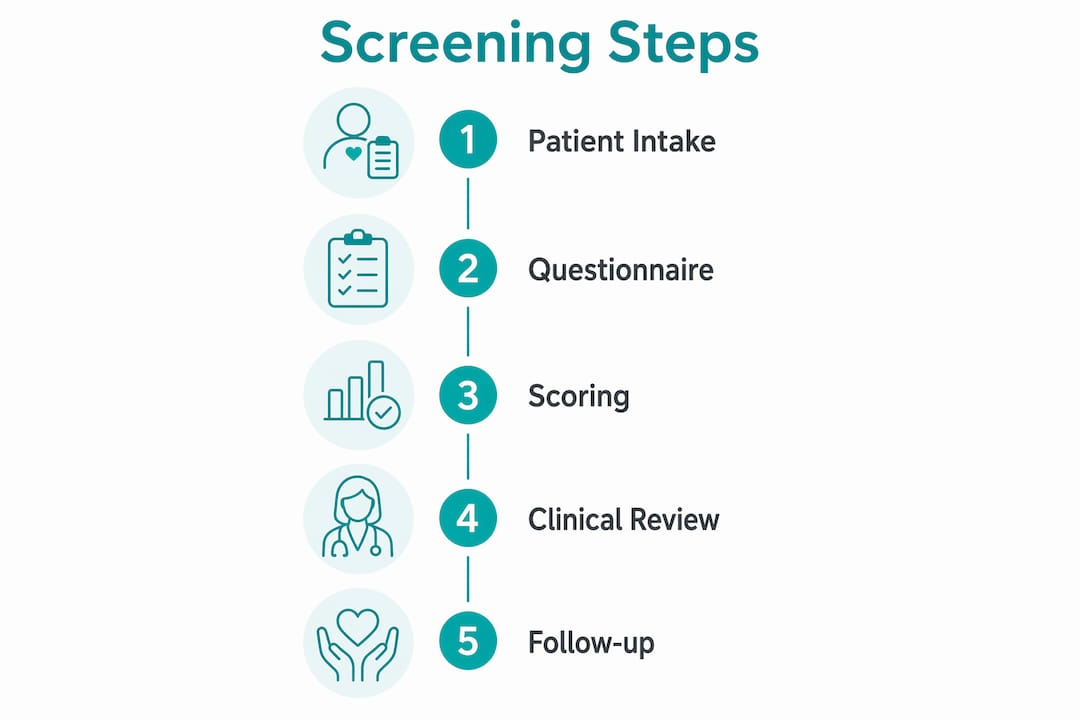
The steps in mental health screening typically follow a clear sequence:
Initial brief screen: The PHQ-2 asks two questions about low mood and loss of interest over the past two weeks. A score of 3 or higher triggers the next step.
Follow-up detailed screen: The PHQ-9 follows up for positives, assessing nine symptom domains including sleep, concentration, energy, and suicidal ideation. At a cutoff of 3, the PHQ-2 yields 83% sensitivity and 90% specificity, with roughly 11% of patients proceeding to the PHQ-9.
Anxiety screening: The GAD-7 measures generalized anxiety severity across seven items, scored from 0 to 21.
Administration: Screens are delivered in person, via telehealth, or through a digital intake portal before the appointment.
Scoring and triage: The clinician reviews scores in the context of the patient’s full presentation, not in isolation.
The PHQ-2 statistic above matters because it shows how precisely calibrated these tools are. A cutoff of 2 instead of 3 would send 26% of patients to the full PHQ-9, creating unnecessary burden without improving detection accuracy.
Pro Tip: Screening timing matters as much as the tool itself. Clinicians often time screenings carefully to match the patient’s presenting concerns rather than administering every tool at every visit. This keeps the process focused and reduces patient fatigue.

What happens after a positive mental health screening?
A positive screen does not mean you have a diagnosis. It means your symptom score has crossed a threshold that warrants a closer look. The next step is a comprehensive psychiatric evaluation, which typically lasts 45 to 90 minutes and includes a structured clinical interview, a mental status examination, and review of medical and family history.
Key elements of a psychiatric evaluation include:
DSM-5-TR diagnostic framework: The DSM-5-TR organizes over 300 diagnostic categories and guides how clinicians assess behavior, mood, and cognition.
Mental status examination: A structured observation of appearance, speech, thought process, mood, and insight.
Safety assessment: Any positive response on PHQ-9 item 9, which asks about thoughts of self-harm or suicide, bypasses routine referral and triggers an immediate safety response regardless of the total score.
Medical rule-out: High PHQ-9 scores prompt clinicians to rule out medical causes such as thyroid dysfunction or medication side effects before confirming a psychiatric diagnosis.
Clinician type: Evaluations are conducted by psychiatrists, psychologists, or psychiatric nurse practitioners depending on the setting.
“A positive screen is the beginning of a conversation, not the end of one. It opens the door to understanding what you are experiencing with the support of a trained clinician.”
For parents navigating this process with a child or teenager, understanding how mental health triage works after a positive screen can reduce anxiety about what comes next. The evaluation is collaborative, not adversarial.
What are the limits of mental health screenings?
Screening tools cannot confirm final psychiatric diagnoses or fully differentiate overlapping symptoms without clinical judgment. A high score on the PHQ-9 does not mean depression is confirmed. A low score does not mean everything is fine. This distinction is one of the most misunderstood aspects of how mental health is assessed.
A negative screen simply means symptom thresholds were not met at that specific moment. Symptoms fluctuate. A person experiencing early-stage depression or anxiety may score below the cutoff one week and above it the next. Screening is a snapshot, not a complete picture.
Several factors affect screening accuracy. Cultural background influences how people describe and report symptoms. Developmental stage matters in pediatric and adolescent psychiatry, where a child with autism spectrum disorder or ADHD may present differently than an adult. Medical conditions, medications, and life circumstances all shape how symptoms appear on a questionnaire.
Pro Tip: If you feel your screening result does not reflect how you actually feel, say so. Screening tools work best when clinicians treat them as conversation starters, not final verdicts. Your lived experience is part of the clinical picture.
Patients sometimes fear that a positive screen will label them permanently or affect their insurance. That fear is understandable, but best practice in psychiatric screening involves respectful, collaborative dialogue focused on your story and needs. The goal is support, not judgment.
How screening fits into psychiatric care in New York
Mental health screening is integrated differently depending on the patient’s age, setting, and presenting concern. The table below shows how screening applies across the main populations served by psychiatric practices in New York.
Population | Common screening tools | Conditions often identified |
Children and adolescents | PHQ-A, Vanderbilt, SCARED | ADHD, anxiety, depression, OCD, school refusal |
Adults | PHQ-9, GAD-7, Edinburgh Scale | Depression, anxiety, postpartum mental health |
Telehealth patients | Digital PHQ-9, GAD-7 intake forms | Depression, anxiety, medication management needs |
For pediatric and adolescent patients in Westchester County and Brooklyn, screening often happens during school-related referrals or annual wellness visits. Conditions like school refusal, ADHD, OCD, and autism spectrum disorder frequently surface through structured screening before a full evaluation is requested.
Adult psychiatry screenings in New York commonly address depression, generalized anxiety, and postpartum and perinatal mental health. The Edinburgh Postnatal Depression Scale is a validated tool used specifically for postpartum screening, and it is now routinely administered during obstetric and pediatric visits.
Telehealth psychiatry services across New York have made screening more accessible. Patients in White Plains, Brooklyn, and throughout the state can complete digital intake questionnaires before their first appointment, allowing clinicians to review scores in advance and focus the consultation on what matters most. After a positive screen, starting psychiatric treatment is a clear and supported process, not a confusing leap into the unknown.
Most insurance plans accepted by psychiatric practices in New York cover both the screening visit and the follow-up evaluation. Verifying your insurance coverage for psychiatric care before your first appointment removes one more barrier to getting started.
Key takeaways
Mental health screening is a validated, structured process that identifies possible conditions early and guides clinical decision-making, but it requires professional interpretation to be meaningful.
Point | Details |
Screening is not diagnosis | A positive PHQ-9 or GAD-7 score opens an evaluation, not a diagnosis. |
Safety questions override all else | Any positive response on PHQ-9 item 9 triggers immediate safety intervention regardless of total score. |
Negative screens need context | A negative result reflects one moment in time and does not rule out emerging symptoms. |
Telehealth expands access | Digital screening tools allow New York patients to complete intake before their first appointment. |
Clinical judgment is required | Cultural, developmental, and medical factors all shape how screening results should be interpreted. |
Why I think we underestimate what a good screening conversation can do
I have seen the difference between a screening that feels like a checkbox exercise and one that genuinely changes the direction of someone’s care. The questionnaire itself is not the point. The point is what a skilled clinician does with the answers.
Most people who come in for a first psychiatric visit are carrying something they have not said out loud to anyone. A well-timed PHQ-9 or GAD-7 gives them permission to say it. The score creates an opening. I have watched patients visibly relax when a clinician says, “Your score suggests you’ve been struggling more than you’ve let on. Tell me about that.” That moment of being seen is often more therapeutic than anything that comes after.
What I find underappreciated is the safety question embedded in the PHQ-9. Item 9 asks directly about thoughts of self-harm. Many patients have never been asked that question by anyone. For some, it is the first time a professional has acknowledged that those thoughts exist. The clinical protocol is clear: any positive response requires immediate action. But the human impact of simply being asked, without shame, is something the research does not fully capture.
Telehealth has changed this dynamic in ways I did not expect. Patients completing digital intake forms at home, before they ever meet a clinician, often answer more honestly than they would face to face. The screen between them and the provider creates just enough distance to lower their guard. That honesty makes the first appointment far more productive.
Screening is not a bureaucratic hurdle. It is the first act of care.
— Martin
Take the first step with 2ndarc
If you or someone you love has been wondering whether a mental health evaluation might help, 2ndarc is here to support you through every stage of that process.

2nd Arc Psychiatric Associates serves children, adolescents, and adults across New York, with in-person care in White Plains and Brooklyn and telehealth services available statewide. The team specializes in conditions including depression, anxiety, ADHD, OCD, autism spectrum disorder, and postpartum mental health. Most major insurance plans are accepted, and appointments are often available within 24 hours. Whether a screening has already raised concerns or you are simply not sure where to start, book your consultation online and connect with a compassionate team ready to listen.
FAQ
What is the purpose of mental health screening?
Mental health screening identifies whether a person’s symptoms have crossed a clinically meaningful threshold, guiding decisions about whether a full psychiatric evaluation is needed. It is a preliminary detection tool, not a diagnostic process.
How is mental health assessed during a screening?
Mental health is assessed using validated questionnaires like the PHQ-9 for depression and the GAD-7 for anxiety, scored against established cutoffs. Clinicians then interpret scores alongside the patient’s history, context, and presenting concerns.
What should I expect in a mental health screening?
You can expect a short series of written or verbal questions about your mood, behavior, sleep, energy, and concentration over the past two weeks. The process typically takes 5 to 15 minutes and is often completed before or during a clinical appointment.
Can a mental health screening give a false result?
Yes. A negative screen does not guarantee the absence of a condition, and a positive screen does not confirm a diagnosis. Screening results are snapshots that require clinical interpretation to be meaningful.
Does telehealth mental health screening work the same way?
Telehealth screening uses the same validated tools as in-person care, often delivered through a digital intake form before the appointment. Research suggests patients sometimes report symptoms more honestly in digital formats, which can improve the quality of the first clinical conversation.
Recommended


Comments