Start Psychiatric Treatment for Depression: A Real Guide
- joeudesign
- May 23
- 8 min read

TL;DR:
Depression develops gradually, often stealing energy and motivation without clear warning signs.
Starting treatment involves showing up honestly for evaluation, guided by a licensed provider who will lead the process.
Depression doesn’t announce itself with a clear starting line. It builds quietly, stealing energy, motivation, and the sense that things could ever feel different. If you’re reading this, you may already know that something needs to change. Yet for many adults, the hardest part isn’t recognizing the problem. It’s knowing how to start psychiatric treatment for depression when the whole system feels foreign and overwhelming. This guide walks you through every step, from what to prepare before your first call to what real progress actually looks like, so you can move from stuck to moving.
Table of Contents
Key takeaways
Point | Details |
You don’t need a diagnosis first | A licensed provider handles evaluation and treatment planning. Your job is simply to show up. |
Telehealth expands your access | Video-based therapy is as effective as in-person care, making New York statewide access far easier. |
Medication takes time to work | Most people see meaningful improvement within 4 to 6 weeks of starting the right antidepressant. |
Early follow-up is non-negotiable | Monitoring within 2 weeks of starting medication helps catch problems before they compound. |
Treatment resistance has options | If two trials fail, specialized approaches like ketamine or TMS exist and should be discussed. |
What you need before starting psychiatric treatment
Most people delay getting help not because they don’t want it, but because they assume they need to arrive with everything figured out. You don’t. Providers expect to guide you through diagnosis and treatment planning. Your only job at the start is to show up honestly.
That said, a little preparation goes a long way toward getting you the right care faster. Here’s what actually matters:
Symptom history: Note when your depression started, how often it occurs, and whether anything reliably makes it better or worse. Even rough estimates are useful.
Past treatment history: List any previous medications, therapy, or psychiatric care. Include what worked, what didn’t, and why you stopped.
Current medications and supplements: Drug interactions matter in psychiatric prescribing. Bring a full list, including vitamins and over-the-counter products.
Family mental health history: Depression often runs in families. This context helps your provider identify treatment approaches likely to work for you.
Insurance information: Know your plan name and member ID. Most quality psychiatric practices, including those offering telehealth across New York, accept a wide range of insurance plans.
Questions you want answered: Write them down before your appointment. Anxiety tends to erase questions the moment you’re in the room.
One underrated step: check whether your insurance covers telehealth psychiatry. Video-based therapy is equally effective to in-person care for depression, and many New York patients use telehealth to avoid long commutes or scheduling gaps. Sessions covered by insurance often cost as little as $0 to $21 out of pocket.
Pro Tip: Don’t wait until you can articulate everything perfectly. The most important thing you can say to a provider is “I’ve been struggling and I need help.” Everything else gets worked out from there.
How to start psychiatric treatment, step by step
Getting from “I need help” to “I have an appointment” is a concrete process, not a mystery. Here’s how it actually works.
Step 1: Schedule your psychiatric evaluation
Call or book online with a psychiatric practice that accepts your insurance. In New York, you can access both in-person care at locations like White Plains and Brooklyn, or use statewide telehealth services. Many practices offer appointments within 24 hours for new patients.
Step 2: Complete your intake paperwork
Before your evaluation, you’ll fill out forms covering your symptoms, medical history, and current medications. First sessions typically involve intake paperwork, symptom assessments, history reviews, and collaborative goal-setting. Being thorough here saves time and helps your provider start with accurate context.
Step 3: Undergo the psychiatric assessment
Your psychiatrist will ask detailed questions about your mood, sleep, energy, concentration, appetite, and whether you’ve had thoughts of self-harm. This is a clinical interview, not a test. There are no wrong answers. Be honest, including about alcohol or substance use, because both significantly affect depression and treatment response.
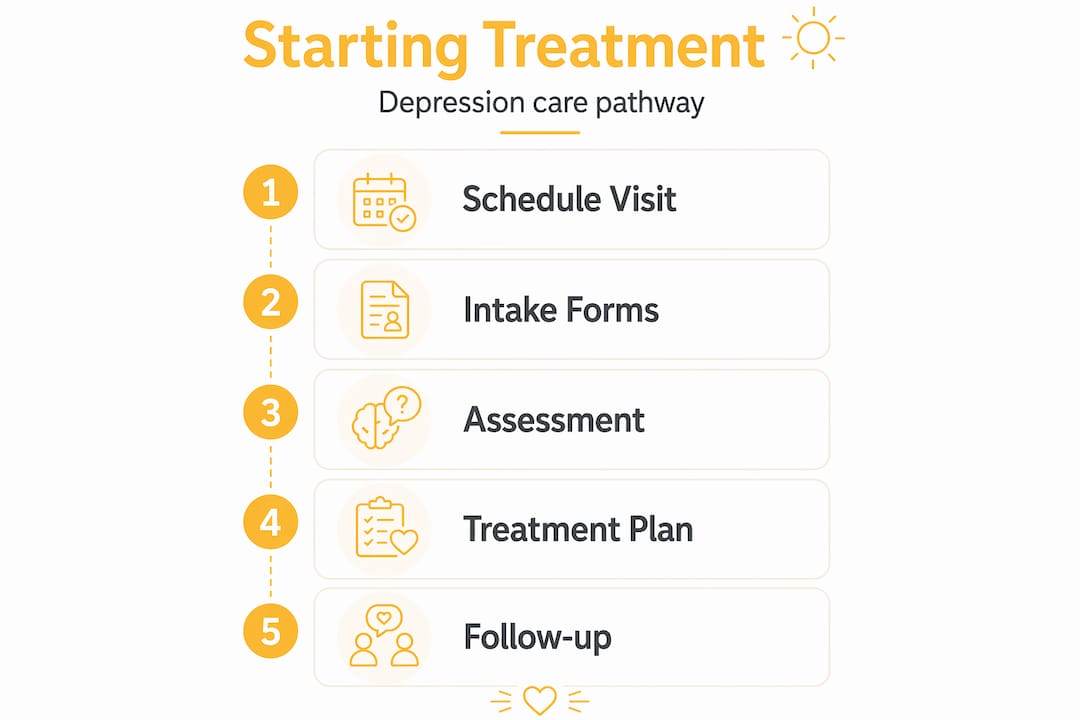
Step 4: Discuss your depression treatment options
After the assessment, your provider will recommend a treatment plan. This typically falls into one of three categories:
Treatment approach | Best suited for | Typical timeline |
Medication only | Moderate to severe symptoms, limited therapy access | 4 to 8 weeks for initial response |
Therapy only | Mild to moderate symptoms, preference for non-medication | 6 to 12 weeks for meaningful change |
Combined medication and therapy | Most common recommendation | Fastest and most durable results |
Antidepressants require a prescription from a licensed provider after clinical evaluation, and most providers combine medication with therapy and lifestyle changes for better outcomes.
Step 5: Begin medication management if prescribed
If your provider starts you on an antidepressant, you’ll typically have a follow-up within two weeks to check for side effects and early response. Symptom improvement usually appears within four weeks of starting an effective medication. Small incremental shifts in sleep, energy, or mood tend to come first. The absence of dramatic early change is not failure.

Step 6: Start psychotherapy
Cognitive behavioral therapy and other evidence-based approaches are often combined with medication for the strongest results. Your therapist and psychiatrist may coordinate care, especially in practices that offer both services.
Pro Tip: If you have a child or adolescent in your household also showing signs of depression, ask the practice whether they offer pediatric or adolescent psychiatry. Getting both of you care from one coordinated team is far easier than managing separate providers.
Common challenges when starting treatment
Starting treatment rarely goes perfectly. Knowing what typically goes wrong helps you stay on course instead of interpreting early friction as failure.
Medication side effects in the first weeks are common and usually temporary. Nausea, headaches, mild sleep disruption, and appetite changes often appear in weeks one and two. Side effects typically ease after several weeks, but close monitoring matters, especially for younger adults due to increased risk of mood changes early in treatment.
Here’s what to track and when to call your provider:
Worsening mood, agitation, or new thoughts of self-harm. Call immediately.
Side effects that are bearable but persistent after two weeks. Schedule a call to discuss.
No change whatsoever in symptoms after four full weeks. Ask about dose adjustment or a medication switch.
Insurance denial or prior authorization issues. Ask your provider’s office to submit clinical documentation. Most get resolved.
“The goal of the first few months is not to feel perfect. The goal is to find a treatment that your body tolerates and that begins to move the needle. Progress is often quiet before it becomes obvious.”
Dose adjustment or switching is standard clinical practice when there’s no improvement after four weeks at a therapeutic dose. This is not a setback. It’s how psychiatric care is supposed to work.
If two separate adequate treatment trials produce no meaningful improvement, that pattern meets the clinical threshold for treatment-resistant depression. Options at that point include augmentation with second-generation antipsychotics, ketamine or esketamine, and transcranial magnetic stimulation (TMS). These are not last resorts. They are specialized tools that work well for the right patients.
What progress actually looks like
One of the most common reasons people abandon treatment is misreading early progress. They expect a dramatic shift and miss the real signal because it arrives quietly.
Understanding what to actually watch for makes a significant difference in whether people stay with treatment long enough for it to work.
Marker | What it looks like early | What it looks like at 8 to 12 weeks |
Sleep quality | Slightly easier to fall asleep | More consistent, restorative sleep |
Energy | Marginally less fatigue some mornings | Sustained energy for more of the day |
Motivation | Occasional interest in something | More consistent engagement in daily tasks |
Mood | Fewer hours of severe low mood | More stable baseline with fewer crashes |
Concentration | Slightly less brain fog | Noticeably improved focus at work or home |
Your provider will monitor symptom changes using standardized tools like the PHQ-9, a brief questionnaire that tracks depression severity over time. Your honest self-report matters here. Depression involves diverse biological pathways that cause real variability in treatment response, which is why personalized plans adjusted over time consistently outperform rigid one-size approaches.
Keep a simple log between appointments. Note your sleep, energy, and mood each morning with a 1 to 10 rating. When you bring that to your follow-up, your provider can make better-informed decisions instead of relying on your recall of the past several weeks.
My perspective on starting treatment
I’ve worked in psychiatric care long enough to recognize the single biggest obstacle to effective treatment: the delay between knowing something is wrong and actually making the call. Most patients I’ve seen in White Plains, Brooklyn, and through New York telehealth services waited months or years longer than they needed to. And the reason is almost never a lack of awareness. It’s fear dressed up as practicality.
People tell themselves they’re not sick enough yet, that they should be able to manage this alone, that the system is too complicated to navigate. All of that is the depression talking. One thing I’ve learned over years of practice: the version of yourself that delays treatment is not a rational decision-maker. It’s a symptom.
What I’ve also seen, repeatedly, is how much better people feel once they’re actually in care. Not because psychiatric treatment is magic, but because beginning depression therapy with a real clinical plan removes the paralyzing uncertainty. You stop trying to diagnose yourself at 2 a.m. and start working with someone who does this every day.
Telehealth has genuinely changed the equation for patients in New York who once faced long waits or long drives. The evidence supports it. And the access it creates for people in rural areas, parents of young children, and anyone managing a demanding schedule is real and meaningful. Use it if it helps you go.
— Martin
Start your care with 2ndarc

If you’re ready to take the first step, 2ndarc makes it straightforward. 2nd Arc Psychiatric Associates offers personalized psychiatric care for depression and related conditions at locations in White Plains and Brooklyn, with telehealth psychiatry available statewide across New York. The team sees adults, adolescents, and children, covering everything from initial evaluations to ongoing medication management and therapy coordination. Most major insurance plans are accepted. Appointments are often available within 24 hours. Book your evaluation online and get the support you’ve been putting off.
FAQ
Do I need a diagnosis before making a psychiatric appointment?
No. You do not need a prior diagnosis before scheduling. The psychiatric evaluation is exactly what determines your diagnosis and treatment plan.
How long does it take for antidepressants to work?
Most people notice the first signs of improvement within 4 to 6 weeks of starting an effective antidepressant. Full benefit often takes 8 to 12 weeks of consistent use.
Can I do psychiatric treatment for depression through telehealth in New York?
Yes. Telehealth psychiatry is available statewide in New York, and video therapy is equally effective to in-person care for depression according to a 2021 meta-analysis.
What if my first medication doesn’t work?
This is common. Dose adjustment or switching medications is standard practice when there’s no improvement after four weeks at therapeutic dose. Your provider will guide you through next steps.
What is treatment-resistant depression?
Treatment-resistant depression is diagnosed when depression does not improve after two adequate treatment trials. Specialized options including ketamine, esketamine, and TMS are effective for many patients in this situation.
Recommended


Comments