What Does ADHD Diagnosis Involve for Children?
- Martin Witriol
- Jun 9
- 8 min read


TL;DR:
An ADHD diagnosis in children requires a clinical assessment based on behavioral criteria, multi-informant reports, and ruling out other conditions. The process involves gathering behavioral data, applying DSM-5 criteria, and confirming symptoms have been present before age 12 and impair function across settings. Accurate diagnosis guides effective treatment and early support, making thorough evaluations essential for children’s developmental success.
An ADHD diagnosis in children is a structured clinical process built on behavioral criteria, multi-informant reports, and the careful exclusion of other conditions. There is no blood test, brain scan, or single questionnaire that confirms ADHD. What does ADHD diagnosis involve for children is a question every concerned parent deserves a clear, honest answer to, and the short version is this: a qualified clinician gathers detailed behavioral data from multiple sources, applies the DSM-5 criteria, and rules out other explanations before reaching a conclusion. Approximately 10% of US children aged 3 to 17 have ADHD, making it one of the most common neurodevelopmental conditions in pediatric care. Understanding the process is the first step toward getting your child the support they need.
What does ADHD diagnosis involve for children: the clinical criteria
The formal term for the diagnostic framework is the Diagnostic and Statistical Manual of Mental Disorders, Fifth Edition, or DSM-5. Every licensed clinician in the United States uses these criteria as the standard for ADHD assessment in children.
DSM-5 requires at least six symptoms of inattention and/or hyperactivity-impulsivity that have persisted for six or more months and impair functioning in two or more settings, such as home and school. That threshold matters because almost every child is occasionally distracted or restless. The diagnosis requires a pattern that is persistent, pervasive, and clearly out of step with the child’s developmental level.
The three recognized presentations are:
Predominantly inattentive: Difficulty sustaining attention, frequent careless mistakes, losing items, being easily distracted, and forgetting daily tasks
Predominantly hyperactive-impulsive: Fidgeting, leaving seats, running or climbing inappropriately, talking excessively, interrupting, and difficulty waiting turns
Combined presentation: Six or more symptoms from both categories, which is the most commonly diagnosed type in school-age children
Two additional criteria are critical. Symptoms must have been present before age 12, confirmed through developmental history and school records. Symptoms must also cause clinically significant impairment in social, academic, or occupational functioning. A child who struggles only at home but performs well at school, or vice versa, does not meet the full diagnostic threshold. This multi-setting requirement is one reason the evaluation draws on input from both parents and teachers.
Understanding how ADHD affects child development helps parents connect these criteria to real behaviors they observe every day.
How does the ADHD evaluation process work, step by step?
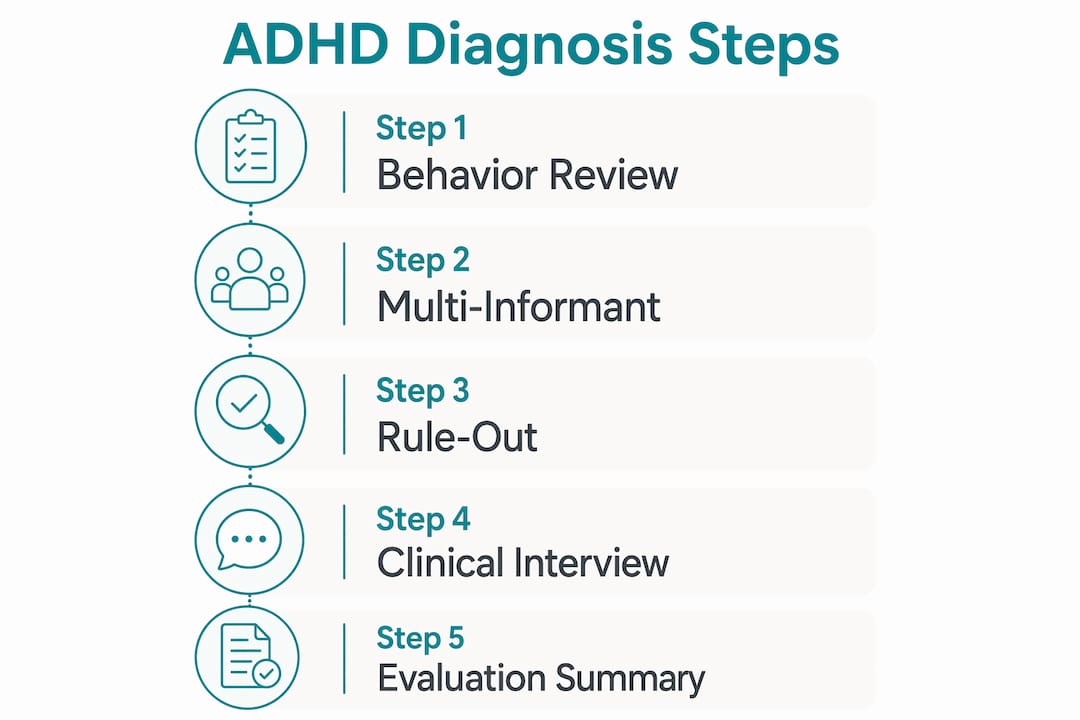
The child ADHD evaluation is not a single appointment. It is a structured sequence of steps designed to build a complete clinical picture. Here is what most families can expect:
Initial consultation with a clinician. A pediatrician, child psychiatrist, or licensed psychologist conducts an intake interview with the parents and, when appropriate, the child. This conversation covers the child’s behavior at home, at school, and in social settings, as well as the family’s concerns and the child’s developmental history.
Standardized rating scales from multiple informants. Rating scales like Conners and Vanderbilt are completed by both parents and teachers. These tools quantify behavioral frequency and severity across settings, giving the clinician objective data rather than relying solely on subjective impressions. Teacher input is especially valuable because it captures behavior in a structured, demanding environment.
Medical examination and sensory screening. A medical exam including hearing and vision tests helps rule out other causes of ADHD-like symptoms. Poor hearing can mimic inattention. Vision problems can cause a child to appear distracted during reading tasks. Thyroid disorders and sleep apnea can also produce behavioral changes that resemble ADHD.
Review of developmental and family history. The clinician will ask about pregnancy, birth history, early developmental milestones, and any family history of ADHD, anxiety, or learning disabilities. Historical school report cards are often requested, particularly for older children or adolescents, to confirm that symptoms were present before age 12.
Differential diagnosis. This is the step that separates a thorough evaluation from a rushed one. Comorbidities are common in over 60% of ADHD cases, including anxiety disorders, mood disorders, learning disabilities, and oppositional defiant disorder. A skilled clinician distinguishes between ADHD and conditions that can look similar, such as generalized anxiety, autism spectrum disorder, or trauma responses.
Synthesis and clinical judgment. The clinician reviews all gathered data and applies the DSM-5 criteria to reach a diagnosis. No single piece of information is sufficient on its own. The diagnosis is the product of the full picture.
Pro Tip: Bring copies of your child’s last two or three report cards and any prior evaluations to the first appointment. This documentation can significantly shorten the evaluation timeline and strengthen the accuracy of the diagnosis.
Common challenges and misconceptions in the ADHD diagnosis process

Many parents arrive at an evaluation with assumptions about what the process involves, and some of those assumptions can delay or complicate getting a clear answer.
The most persistent misconception is that a brain scan or EEG can confirm ADHD. Brain scans and EEGs are not diagnostic for ADHD. They may be ordered to rule out seizure disorders or other neurological conditions, but they cannot detect ADHD itself. The diagnosis is fully clinical, meaning it rests entirely on behavioral evidence and clinical judgment, not physiological biomarkers.
A second major challenge is underdiagnosis in specific populations:
Girls are significantly more likely to present with the inattentive type, which is less disruptive and therefore more easily overlooked by teachers and parents
Minority children face underdiagnosis due to less disruptive symptoms being attributed to other factors, including cultural or socioeconomic explanations
Younger children in a grade cohort are sometimes misidentified because their relative immaturity is mistaken for ADHD symptoms
“Early identification of ADHD is crucial to prevent academic and social impairment later in life.” — ADHD Clinical Review
This is not a minor concern. A child who goes undiagnosed through elementary school often accumulates years of academic struggle, social friction, and damaged self-esteem before anyone connects the dots. The cost of a missed diagnosis is real and measurable. For a deeper look at how these patterns develop, the 2ndarc resource on understanding ADHD in pediatrics covers the clinical nuances well.
How to prepare for your child’s ADHD evaluation
Preparation makes a meaningful difference in how smoothly and accurately the evaluation proceeds. Parents who arrive organized give the clinician richer data to work with, which leads to a more confident diagnosis.
Here is what to gather before the appointment:
Behavioral observations written down. Note specific incidents, not general impressions. “He got up from his homework chair 11 times in 20 minutes” is more useful than “he can’t focus.”
School records. Report cards, teacher comments, any prior academic or psychological testing, and records of disciplinary incidents or accommodations
Developmental history. Pregnancy and birth details, early milestone timing, any speech or motor delays, and prior diagnoses or evaluations
Family medical history. ADHD, anxiety, depression, learning disabilities, and autism spectrum disorder all have genetic components that inform the clinical picture
Questions worth asking the evaluating clinician include: What rating scales will you use? Will you contact the school directly? How long will the process take? What happens if the results are inconclusive?
Pro Tip: If your child’s school has a counselor or special education coordinator, ask them to complete the teacher rating scale before the appointment. Having that data ready at the first visit saves time and adds a critical informant perspective.
Telehealth has changed access to psychiatric evaluation in meaningful ways. Families in Westchester County, Brooklyn, and across New York State can now complete much of the ADHD assessment process remotely, including the clinical interview, parent rating scales, and follow-up consultations. For families with limited transportation, demanding work schedules, or children who are anxious about clinical settings, this option removes real barriers. After a diagnosis is confirmed, the next step is building a treatment plan, and ADHD treatment options for kids covers that territory in practical detail.
Key takeaways
An accurate ADHD diagnosis in children requires DSM-5 criteria, multi-informant behavioral data, medical rule-out, and differential diagnosis, with no single test capable of confirming the condition alone.
Point | Details |
No single test confirms ADHD | Diagnosis is fully clinical, based on behavioral evidence and DSM-5 criteria, not brain scans or blood work. |
Six symptoms across two settings | DSM-5 requires at least six inattentive or hyperactive-impulsive symptoms impairing function in home and school. |
Multi-informant data is required | Conners and Vanderbilt rating scales from parents and teachers are standard tools in every thorough evaluation. |
Underdiagnosis is a real risk | Girls and minority children are frequently missed due to less disruptive inattentive presentations. |
Preparation accelerates accuracy | Bringing school records, behavioral notes, and developmental history to the first appointment improves diagnostic confidence. |
Why accurate diagnosis matters more than a quick answer
I have worked with children across a wide range of ADHD presentations, from the hyperactive six-year-old whose teacher flagged concerns immediately, to the quietly struggling ten-year-old girl whose inattentive symptoms were written off as daydreaming for years. What strikes me most consistently is how much the quality of the evaluation shapes everything that follows.
Parents sometimes come in hoping for a fast answer, and I understand that impulse completely. When your child is struggling, you want clarity and you want it now. But a rushed evaluation that skips teacher input, glosses over the differential diagnosis, or fails to ask about anxiety and learning disabilities does real harm. It either misses the diagnosis entirely or confirms ADHD when something else is actually driving the behavior.
The evaluations I find most valuable are the ones where parents arrive prepared, teachers have completed their rating scales, and we have enough developmental history to build a timeline. That combination gives us the confidence to say, with genuine clinical certainty, what is happening and what to do about it. Telehealth has made this kind of thorough evaluation more accessible for families across New York, and that access matters enormously for the children who would otherwise wait months for an in-person appointment.
If you are concerned about your child, do not wait for the symptoms to become a crisis. Seek an evaluation now, ask good questions, and expect a process that takes your child’s full picture seriously.
— Martin
Start your child’s evaluation with 2ndarc
If you are ready to take the next step, 2ndarc makes it straightforward for families across New York to access a thorough, compassionate psychiatric evaluation for their child.

2ndarc’s telehealth first visit evaluation is designed specifically for children and adolescents, with appointments often available within 24 hours. The care team at 2ndarc serves families in White Plains, Westchester County, Brooklyn, and statewide through telehealth, accepting most major insurance plans. Whether your child needs an initial ADHD assessment or a second opinion on a prior evaluation, 2ndarc’s pediatric and adolescent psychiatry team is ready to listen, collaborate, and build a plan that fits your child’s needs. Book your appointment online today.
FAQ
What does an ADHD diagnosis involve for a child?
An ADHD diagnosis involves a clinical evaluation using DSM-5 criteria, standardized rating scales from parents and teachers, a medical exam to rule out other conditions, and a review of developmental history. No single test confirms ADHD; the diagnosis is based on behavioral evidence gathered across multiple settings.
How long does the ADHD evaluation process take?
The process typically spans one to several appointments, depending on the clinician and how much information is available upfront. Having school records, behavioral observations, and completed rating scales ready before the first visit can shorten the timeline significantly.
Can a pediatrician diagnose ADHD, or does my child need a specialist?
Pediatricians are qualified to diagnose ADHD and often serve as the first point of contact. For complex cases involving comorbid anxiety, learning disabilities, autism spectrum disorder, or inconclusive findings, a referral to a child psychiatrist or psychologist provides a more detailed evaluation.
Is ADHD diagnosed differently in girls than in boys?
The DSM-5 criteria are the same regardless of gender, but girls are more likely to present with the inattentive type, which is less visible and more frequently missed. Parents and teachers should be aware that ADHD in girls often looks like quiet distraction rather than disruptive hyperactivity.
What happens after an ADHD diagnosis is confirmed?
After diagnosis, the clinician works with the family to build a personalized treatment plan that may include behavioral therapy, school accommodations, medication management, or a combination. Early intervention produces significantly better academic and social outcomes over time.
Recommended


Comments